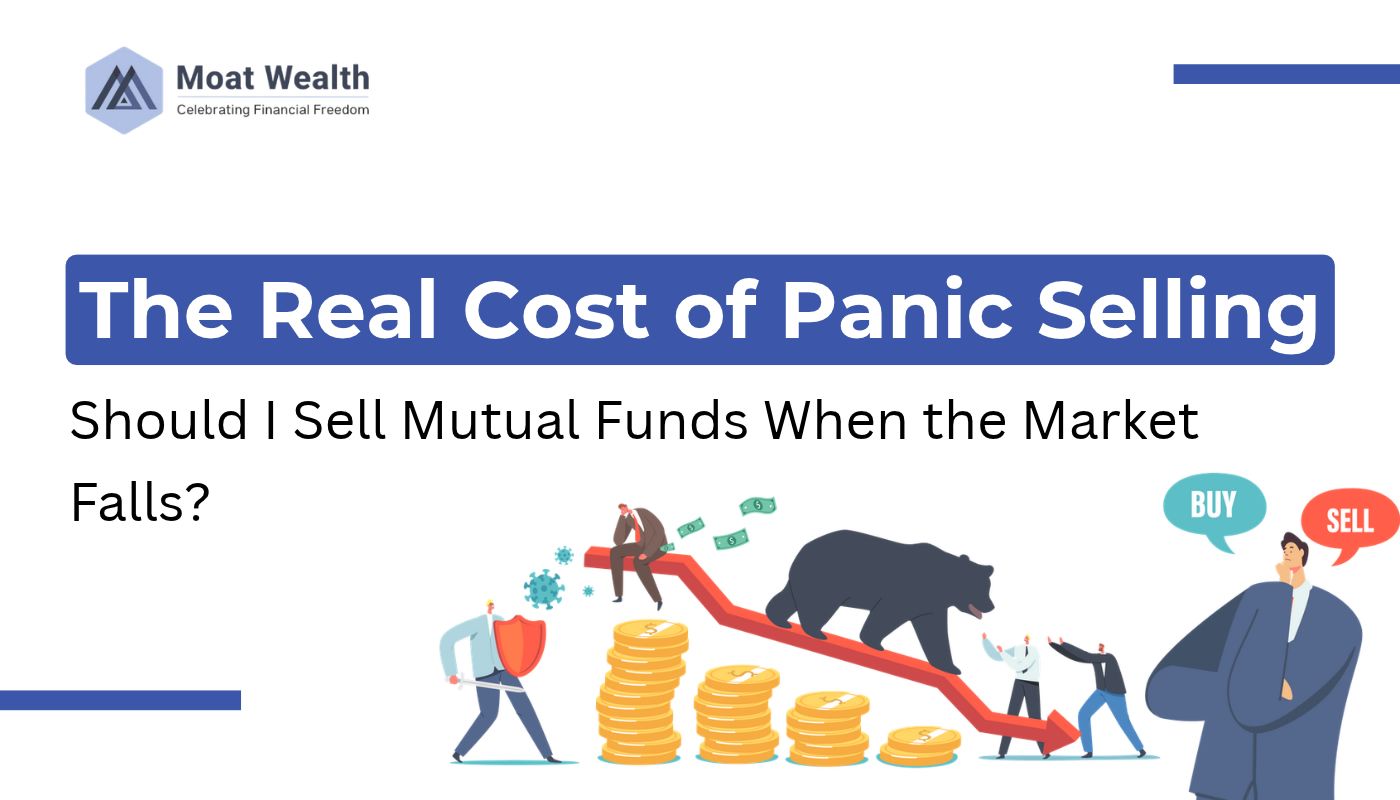
Should I sell mutual funds when the market falls? It is the question most investors ask during a correction, and for long-term investors, the answer is usually “No”. Selling in a panic turns a temporary fall into a permanent loss, adds taxes and exit loads, and often means missing the recovery. Here is what panic selling really costs, and what to do instead.
Why Selling Feels Like the Right Move
Watching your portfolio shrink is uncomfortable. Behavioural research has long shown that people feel the pain of a loss more strongly than the pleasure of an equal gain.
In a falling market, that instinct pushes investors to sell simply to make the discomfort stop. It feels like protection. In practice, it usually works against you.
When you decide to sell out of fear and panic, it costs you the following:
Cost 1: A Paper Loss Becomes a Real One
When the Net Asset Value (NAV) of your fund falls, you still own exactly the same number of units. The loss exists only on paper.
Your fund still holds the same companies, and their long-term prospects rarely change in a few weeks of market turbulence.
The moment you redeem, the loss becomes permanent, and you no longer own the units that would have benefited from a recovery.
Cost 2: You Have to Be Right Twice
Selling during a fall only pays off if you time two decisions correctly, when to get out and when to get back in. Most investors wait for things to “feel safe” before reinvesting, and by then markets have often moved up.
Here is a simple illustration. Two investors each hold ₹10 lakh in an equity fund when the market falls 25%.
| Investor A stays invested | Investor B sells and re-enters later | |
| Value after a 25% fall | ₹7.5 lakh | Sells at ₹7.5 lakh |
| Market rises 20% from its low | ₹9 lakh | Reinvests ₹7.5 lakh here |
| Market returns to its earlier peak | ₹10 lakh | About ₹8.33 lakh |
This is a hypothetical example for illustration only.
Investor B ends up about ₹1.67 lakh behind, before counting any taxes or exit loads, even though the market fully recovered.
Cost 3: Taxes and Exit Loads Reduce What You Keep
Redeeming equity mutual fund units can trigger tax. Gains on units held for 12 months or less are taxed at 20% as short-term capital gains. Gains on units held longer are taxed at 12.5% as long-term capital gains, with the first ₹1.25 lakh in a financial year exempt. These rates have applied since 23 July 2024.
(Source: Economic Times India)
Many equity funds also charge an exit load, often around 1%, if units are redeemed within a year of purchase. The exact terms vary by scheme and are listed in its Scheme Information Document.
Cost 4: You Break the Habit That Builds Wealth
Panic does not only show up as redemptions. It also shows up as stopped Systematic Investment Plans (SIPs). In March 2026, a month of sharp market declines, 53.38 lakh SIPs were discontinued or reached maturity, slightly more than the 52.82 lakh new SIPs registered, according to data from the Association of Mutual Funds in India (AMFI).
(Source: Economic Times India)
Not every closed SIP was a panic decision, since some simply completed their term. But stopping a SIP during a fall means giving up the chance to buy units at lower prices, exactly when rupee cost averaging works best.
Most Long-Term Investors Are Holding On
The encouraging news is that more Indian investors are staying the course. Speaking at ASSOCHAM’s Mutual Fund Summit on 3 July 2026, a Whole-Time Member of the Securities and Exchange Board of India (SEBI) noted that over 61% of retail mutual fund assets stay invested for more than 24 months.
(Source: Outlook Money)
When Selling Can Make Sense
Not every sale is a panic sale. Redeeming can be the right decision when:
- You have reached a goal and need the money soon.
- Your fund has consistently underperformed its benchmark and category over several years, not just a few weeks.
- Your asset allocation has drifted and you are rebalancing as part of a plan.
The difference is that these decisions are based on your goals, not on the day’s headlines.
Also Read: Market Corrections Are Normal: How Indian Markets Have Recovered After Past Falls
The Bottom Line
A falling market tests every investor’s discipline. Selling may bring short-term relief, but it often costs far more than the fall itself. If your goals have not changed, your investments usually should not either.
If you are unsure whether to hold, switch or rebalance, speak to a Moat Wealth advisor before you act.
Disclaimer: This article is for educational purposes only and does not constitute investment advice. Mutual fund investments are subject to market risks. Read all scheme-related documents carefully. Past performance is not indicative of future returns. Moat Wealth Associates LLP is not a SEBI-registered IA. Content on this website and all other platforms of Moat Wealth Associates LLP is for educational/ informational purposes only.