
Foreign portfolio investors (FPIs), still widely referred to as foreign institutional investors (FIIs), pulled a net USD 82 a barrel in July to USD 116 in September, adding to pressure on India’s external finances.
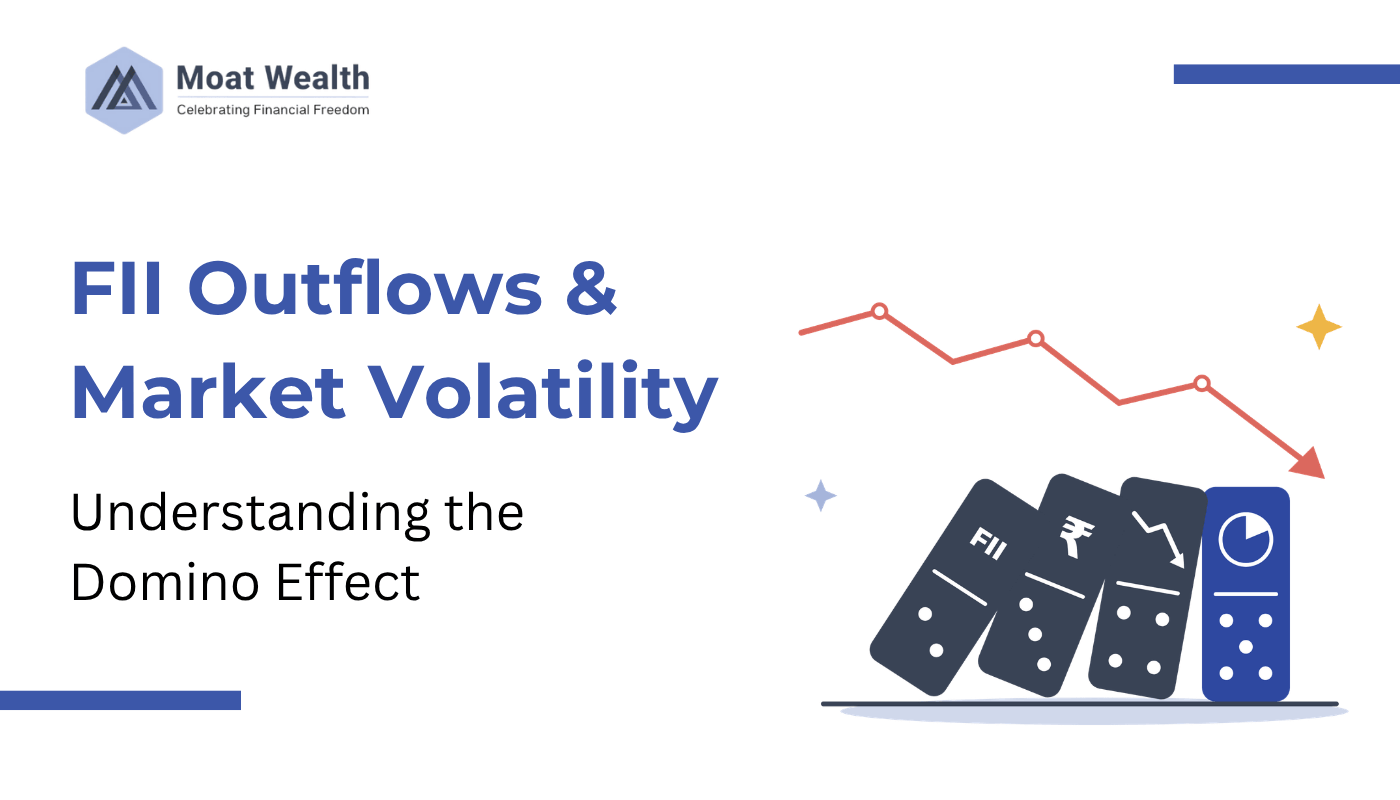
FII selling and the Indian stock market are linked through a chain of effects that runs from share prices to the currency and back. Each link can also weaken along the way, which is why the same selling does not always lead to the same fall.
(Source: RBI, Governor’s Statement, 7 October 2026)
Why Foreign Investors Are Selling Indian Stocks
FII outflows happen when foreign investors sell more Indian securities than they buy over a period. The Securities and Exchange Board of India (SEBI) has officially called these investors FPIs since 2014, though the market still widely uses the older term.
In 2026, rising bond yields in advanced economies, volatile crude oil prices and a strong dollar have weighed on Indian equities. At the same time, artificial intelligence (AI) and semiconductor stocks in markets such as South Korea and Taiwan have drawn foreign capital away.
Much of this foreign investor selling in the Indian stock market reflects global repositioning rather than a verdict on India. In September, foreign investors were still buying Indian initial public offerings (IPOs) in the primary market even as they sold listed shares in the secondary market.
How FII Outflows Affect the Indian Stock Market
Heavy foreign selling puts pressure on stocks and sectors where foreign investors hold large positions, such as banking and information technology (IT), especially when there are not enough buyers to absorb it. The effect varies with liquidity and company-specific news, so the headline index can hide wide differences between stocks and sectors.
What has changed is who sits on the other side of those trades. Domestic institutional investors (DIIs) such as mutual funds and insurers now provide strong buying support, backed by a steady base of household savings, with systematic investment plan (SIP) contributions reaching ₹32,297 crore in August 2026, though not all of it goes into shares in the same month.
That support does not always fully offset foreign selling or stop prices from falling, but it can limit how far and how fast they fall.
(Source: Association of Mutual Funds in India (AMFI), Monthly Note, August 2026)
How FII Outflows Impact the Indian Rupee
When foreign investors take their sale proceeds out of India, they may convert rupees into dollars or another currency, which can raise demand for the dollar and push the rupee down. For unhedged foreign investors, a weaker rupee also lowers the dollar value of the Indian shares they still hold.
A possible feedback loop: foreign selling → weaker rupee → lower dollar returns → more foreign selling
This loop is not automatic, since export earnings, other capital inflows and oil prices also affect the exchange rate. India’s foreign exchange reserves, which stood at US$734.6 billion on 2 October 2026, also give the RBI room to manage sharp moves.
The RBI does not try to hold the rupee at a fixed level. Instead, it steps in to prevent sharp swings so the currency moves in an orderly way.
On 10 October 2026, the RBI announced a special facility to meet the dollar needs of three public-sector oil marketing companies through designated banks, effective 12 October. It also tightened rules on rupee currency derivatives, including a ban on rebooking cancelled contracts and lower limits for hedges without an underlying exposure.
(Source: RBI, Governor’s Statement, 7 October 2026, special dollar window and foreign exchange market measures, 10 October 2026)
Currency Risk in the Indian Stock Market
A weaker rupee raises the cost of imports, especially crude oil, which can push up inflation and squeeze margins for companies that rely on imported inputs. Exporters such as IT and pharmaceutical companies may benefit, though hedging, imported inputs and foreign-currency debt can reduce the gain.
When share prices and the rupee fall together, uncertainty can intensify and contribute to wider price swings. This is why foreign institutional investors and market volatility stay closely linked.
For non-resident Indians (NRIs), a falling rupee lowers the dollar value of Indian investments, even if their rupee value is unchanged, though each dollar sent to India now converts into more rupees. The net effect depends on where their future expenses lie, so those with goals abroad, such as a child’s overseas education, should check their currency exposure separately.
What Indian Investors Should Watch During FII Outflows
Monthly FPI flow data shows how large and persistent the selling is, while DII flows show whether domestic buying is keeping pace. The dollar-rupee exchange rate and crude oil prices show the pressure on the rupee, and India VIX, the National Stock Exchange’s volatility index, reflects how much the options market expects the Nifty 50 to swing over the next 30 days.
These signals are most useful as trends over several weeks. No single indicator, and no single month of selling, predicts where the market goes next.
Follow the Chain, Not the Headlines
Foreign flows, the rupee and market volatility are best read as linked signals, each shaped by domestic buying, global conditions, RBI action and company earnings, rather than as a reason to react to any one headline.
For investors whose goals and time horizon have not changed, that usually means continuing SIPs and reviewing allocation against long-term goals. Selling only because foreign investors are selling rarely serves a long-term plan.
Also Read: Investing in Volatile Times: How to Stay Rational When Markets Turn Uncertain
Disclaimer: Content on all platforms of Moat Wealth Associates LLP is for educational/ informational purposes only. The materials/information on this website are for information, financial literacy and educational purposes only. Moat Wealth Associates LLP is not a SEBI-registered IA.