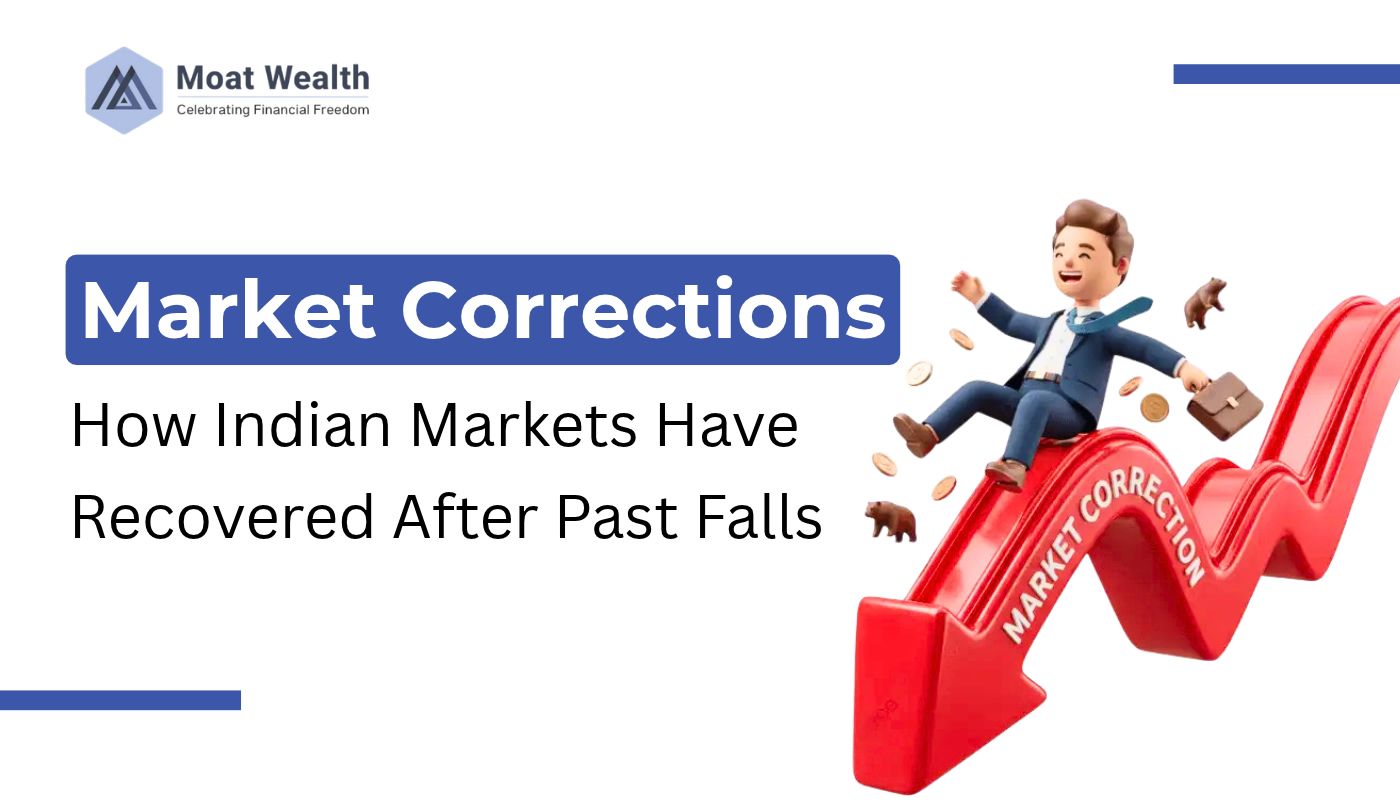
During a market correction, the portfolio values drop, headlines turn gloomy, and the instinct is to protect what is left. It can feel alarming when it is happening. Yet corrections are a normal, recurring part of how equity markets work. Indian markets have been through many of them, and each time they have eventually recovered and gone on to reach new highs.
What Is a Market Correction?
A market correction is commonly described as a fall of 10% or more from a recent peak. A fall of more than 20% is often called a bear market.
Corrections can be triggered by global crises, interest rate changes, foreign investor outflows, or simply by prices running ahead of company earnings.
What matters for an investor is not whether corrections will happen. They will. What matters is how markets have behaved after them.
Major Market Corrections in India and How Markets Recovered
The table below tracks the Nifty 50 through four major falls since 2008, based on closing values.
| Event | Peak | Low | Fall | Back above previous peak |
| Global Financial Crisis | 6,287.85 (Jan 2008) | 2,524.20 (Oct 2008) | About 60% | November 2010 |
| 2015–16 slowdown | 8,996.25 (Mar 2015) | 6,987.05 (Feb 2016) | About 22% | March 2017 |
| COVID-19 crash | 12,362.30 (Jan 2020) | 7,610.25 (Mar 2020) | About 38% | November 2020 |
| 2022 global rate hikes | 18,477.05 (Oct 2021) | 15,293.50 (Jun 2022) | About 17% | November 2022 |
Source: NSE Indices, Historical Index Data
1. 2008: The Global Financial Crisis
The collapse of Lehman Brothers in September 2008 set off a worldwide financial crisis. The Nifty 50 lost about 60% of its value between January and October 2008, the deepest fall in its history.
It was also followed by one of its strongest recoveries. The index regained its 2008 peak by November 2010.
2. 2015–16: A Slow, Grinding Correction
This fall had no single trigger. A slowdown in China, the devaluation of the Chinese yuan in August 2015, falling commodity prices and steady foreign investor selling pulled the Nifty 50 down by about 22% over nearly a year. The index crossed its previous high again in March 2017.
3. 2020: The COVID-19 Crash
As lockdowns spread across the world, the Nifty 50 fell about 38% in roughly two months, reaching its low on 23 March 2020.
It was one of the fastest falls on record, and one of the fastest recoveries too. By November 2020, the index was back above its January peak.
4. 2022: Inflation and Rising Interest Rates
High inflation led central banks across the world to raise interest rates sharply in 2022, while the Russia–Ukraine conflict added to the uncertainty.
The Nifty 50 fell about 17% from its October 2021 high to its June 2022 low, and reached a new high by late November 2022.
What These Recoveries Have in Common
Each correction had a different cause, and each felt different while it was happening. But three patterns repeat.
- Falls have been temporary. Every one of these declines was eventually recovered in full.
- Recovery time has varied. It took under a year after the COVID-19 crash and close to three years after 2008. Investors cannot predict the timing, which is why patience matters.
- The long-term direction has been upward. The Nifty 50 began with a base value of 1,000 in November 1995. Despite every crisis since, it has grown many times over.
Source: NSE Indices, Nifty 50
Past performance does not guarantee future returns. The pattern is still a valuable reminder that a correction is a phase, not an ending.
Where Today’s Market Fits In
Indian markets have been going through a correction through 2026, and it is natural to feel uneasy. Seen against this history, however, the current fall looks like part of a familiar cycle.
No one can say exactly when a recovery will begin, but history suggests that reacting to a correction with panic has rarely served long-term investors well.
What This Means for You
A correction is a good moment to look at your investments calmly.
- Stay invested if your goals and time horizon have not changed.
- Continue your Systematic Investment Plans (SIPs) so you keep buying at lower prices.
- Keep money needed in the short term out of equities, so a fall never forces you to sell.
- Review your asset allocation and rebalance if the correction has shifted it.
Also Read: Why Volatile Markets Create Opportunities for Long-Term Investors
Conclusion
Market corrections are not a sign that something has gone permanently wrong. They are a regular feature of investing in equities, and Indian markets have recovered from every major fall in their history. Investors who understand this are better placed to stay calm, stay invested, and give their wealth the time it needs to grow.
If you would like to review your portfolio in light of the current market, speak to a Moat Wealth advisor.
Disclaimer: This article is for educational purposes only and does not constitute investment advice. Mutual fund investments are subject to market risks. Read all scheme-related documents carefully. Past performance is not indicative of future returns. Moat Wealth Associates LLP is not a SEBI-registered IA. Content on this website and all other platforms of Moat Wealth Associates LLP is for educational/ informational purposes only.