

Building wealth is only half the journey. Preserving and growing it requires ongoing discipline, and one of the most overlooked aspects of wealth management is portfolio rebalancing.
Many investors spend considerable time selecting investments but rarely revisit their portfolios after making those allocations. Over time, market movements, changing financial goals, and evolving economic conditions can cause a carefully constructed portfolio to drift away from its intended strategy.
For high-net-worth individuals (HNIs), portfolio rebalancing is about ensuring that investments continue to align with long-term objectives and risk tolerance, rather than reacting to market noise.
What Is Portfolio Rebalancing?
Portfolio rebalancing is the process of reviewing and adjusting your investment allocation to bring it back in line with your desired asset mix.
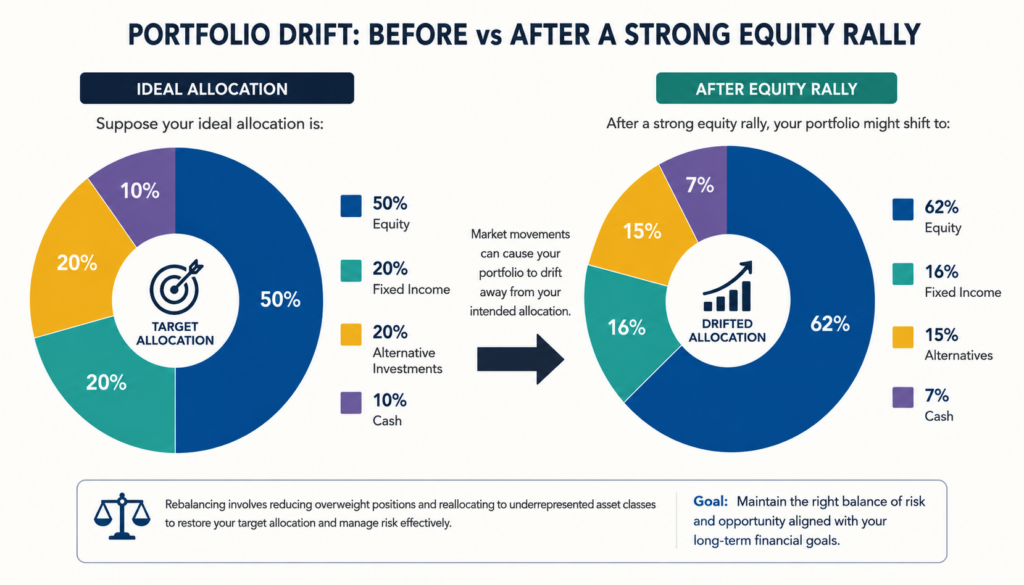
Although your portfolio has grown in value, it now carries significantly more equity risk than originally intended. Rebalancing involves reducing overweight positions and reallocating capital to underrepresented asset classes to restore your target allocation.
The main goal is to ensure your portfolio continues to reflect your financial objectives, rather than just maintaining the percentages.
Why Rebalancing Matters More for HNIs
High-net-worth portfolios are often more complex than traditional investment portfolios.
They may include:
- Listed equities
- Bonds
- Alternative Investment Funds (AIFs)
- Private equity
- Private credit
- Real estate
- Global investments
- Structured products
- Cash and liquid assets
Each asset class behaves differently across market cycles. Left unchecked, a strong performer can gradually dominate the portfolio, increasing concentration risk and reducing diversification.
Regular rebalancing helps maintain the strategic asset allocation that was designed to support long-term wealth creation while managing downside risk.
Also Read: How Much of Your Portfolio Should Be Allocated to AIFs?
How Often Should You Rebalance?
There is no universal rule, but for most HNIs, a structured review process works better than frequent trading.
Quarterly Portfolio Reviews
A quarterly review allows investors to assess:
- Significant changes in asset allocation
- Market developments
- Economic conditions
- Liquidity requirements
- New investment opportunities
Importantly, a quarterly review doesn’t necessarily mean making changes every three months. It simply ensures the portfolio remains aligned with the investment strategy.
Annual Strategic Rebalancing
For many investors, a comprehensive annual rebalance is sufficient.
This involves:
- Restoring target asset allocation
- Reviewing underperforming investments
- Assessing tax implications
- Evaluating changes in financial goals
- Incorporating new investment opportunities
Annual rebalancing provides enough time for long-term investments to perform while preventing excessive portfolio drift.
Event-Based Rebalancing
Sometimes, rebalancing should be triggered by life events rather than the calendar.
Examples include:
- Sale of a business
- Large inheritance
- Significant bonus
- Retirement
- Change in risk tolerance
- Major market corrections
- Regulatory or tax changes
These events often alter both your financial position and investment objectives, making a portfolio review essential.
Related article: Investing in Volatile Times: How to Stay Rational When Markets Turn Uncertain
Don’t Rebalance Based on Market Headlines
One of the biggest mistakes investors make is confusing rebalancing with market timing.
Selling investments simply because markets have risen, or buying aggressively because markets have fallen, is not a disciplined rebalancing strategy.
Instead, decisions should be guided by your long-term asset allocation, not short-term market sentiment.
A structured rebalancing process helps remove emotion from investing, reducing the temptation to chase recent winners or exit quality investments during periods of volatility.
Consider Taxes and Costs
Every portfolio adjustment has potential costs.
Before rebalancing, investors should evaluate:
- Capital gains tax implications
- Transaction costs
- Exit loads or lock-in periods
- Liquidity constraints
- Impact on long-term investment objectives
In some cases, gradually redirecting new investments toward underweight asset classes may achieve the desired allocation without triggering unnecessary taxes or transaction costs.
For HNIs with substantial holdings, tax-efficient rebalancing can meaningfully improve long-term outcomes.
Alternatives Require a Different Approach
Alternative investments deserve special consideration during rebalancing.
Unlike listed equities, investments such as private equity, venture capital, infrastructure funds, and private credit often have:
- Long lock-in periods
- Capital call structures
- Delayed distributions
- Limited liquidity
Because these investments cannot always be bought or sold on demand, rebalancing should account for expected capital calls, future distributions, and the role alternatives play within the broader portfolio.
Rather than treating alternatives as tactical investments, they should be viewed as strategic long-term allocations.
You may also like: Alternate Investment Funds (AIFs) in India: A Complete Investor Guide
Questions to Ask During Every Portfolio Review
Instead of focusing solely on returns, investors should ask:
- Does my current allocation still reflect my financial goals?
- Has my risk exposure increased beyond my comfort level?
- Am I overly concentrated in a particular sector or asset class?
- Have my liquidity needs changed?
- Are there structural opportunities worth incorporating?
- Has my tax situation changed?
- Does my portfolio remain sufficiently diversified?
These questions often provide more valuable insights than simply reviewing short-term performance.
The Value of a Disciplined Process
Successful investing is rarely about making dramatic portfolio changes. More often, it is the result of consistently following a well-defined investment strategy.
A disciplined rebalancing framework helps investors:
- Maintain diversification
- Manage portfolio risk
- Avoid emotional decision-making
- Capture opportunities systematically
- Stay aligned with long-term financial objectives
Over time, this discipline can be just as important as selecting the right investments.
The Bottom Line
For high-net-worth investors, portfolio rebalancing should be viewed as an ongoing strategic exercise rather than a reaction to market movements.
A combination of quarterly reviews, annual strategic rebalancing, and event-driven assessments offers a practical framework for keeping portfolios aligned with evolving financial goals. The objective is not to maximise short-term returns but to maintain the right balance of growth, stability, liquidity, and diversification throughout changing market cycles.
At Moat Wealth, we believe wealth management extends beyond investment selection. Regular portfolio reviews, disciplined rebalancing, and thoughtful asset allocation are essential to building resilient portfolios that can adapt to changing markets while remaining focused on long-term wealth creation.
Disclaimer: Content on all platforms of Moat Wealth Associates LLP is for educational/ informational purposes only. The materials/information on this website are for information, financial literacy and educational purposes only. Moat Wealth Associates LLP is not a SEBI-registered IA.